
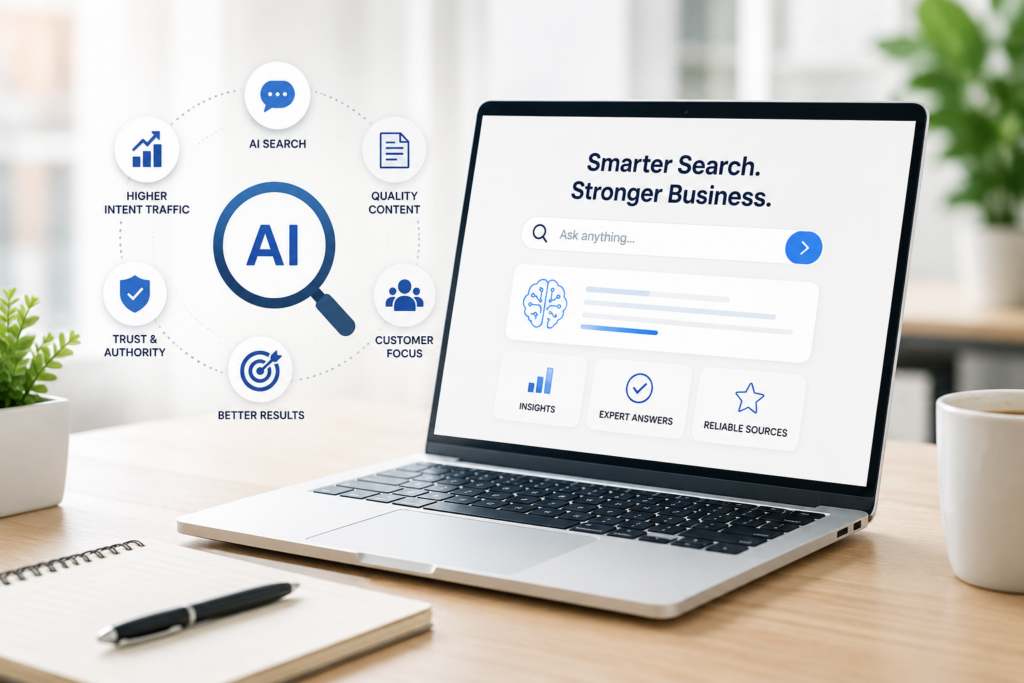
If your website traffic has fallen over the past year, you’re not alone. The way people search online is changing rapidly, with AI-powered tools increasingly answering questions before users ever click on a website.
While this shift has caused concern for many businesses, there’s another side to the story. AI search is often sending fewer visitors, but those visitors are arriving with much stronger purchase intent.
Understanding why this is happening and how your marketing strategy should adapt will be essential for staying competitive in 2026.
What Is AI Search?
AI search goes beyond matching keywords to webpages. It aims to understand what a user is asking and provide a direct, conversational answer.
Unlike traditional search engines, AI tools allow users to ask follow-up questions, request comparisons and refine their search without starting over.
Today, some of the most widely used AI search platforms include:
- ChatGPT Search
- Google AI Overviews
- Google Gemini
- Microsoft Copilot
- Perplexity AI
This conversational experience is changing how customers research products, services and businesses before making a decision.
AI Search vs Traditional Search
Traditional search usually involved entering a keyword, opening several websites and comparing the information manually.
AI search has simplified much of that process.
| Traditional Search | AI Search |
| Keyword searches | Natural conversations |
| Multiple website visits | AI-generated answers |
| Manual research | Instant comparisons |
| Search rankings drive visibility | AI recommendations influence visibility |
Instead of searching several websites for answers, users can now receive a summary within seconds. If they need more information, they simply ask another question.
As a result, businesses are no longer competing only for search rankings. They are increasingly competing to become one of the trusted sources AI platforms choose to reference.
Why Website Traffic Is Falling
One of the biggest concerns surrounding AI search is declining website traffic.
Many informational searches now end before a user visits a website because the AI platform has already provided the answer.
For example, someone searching “What is local SEO?” may receive a complete explanation directly within Google’s AI Overview or ChatGPT.
However, fewer clicks do not necessarily mean fewer opportunities.
Users still visit websites when they want to compare providers, understand pricing, view case studies or speak with an expert. AI is simply reducing visits from people who were only looking for a quick definition or basic information.
Businesses should therefore focus less on traffic volume and more on the quality of the visitors arriving on their website.
Why AI Traffic Converts Better
AI search is changing where customers enter the buying journey.
Instead of arriving with little understanding of a service, many visitors have already completed much of their research before clicking through.
By the time they reach your website, they have often:
- identified their challenge
- compared different solutions
- evaluated several providers
- narrowed down their shortlist
This creates visitors with stronger purchase intent.
Rather than explaining what your service is, your content should focus on why your business is the right choice. Demonstrating experience, showcasing successful projects and answering common customer questions become even more valuable.
Quality leads are increasingly replacing high traffic numbers.
How AI Chooses Which Brands to Recommend
Ranking highly on Google is no longer the only measure of online success.
AI platforms decide which businesses to reference based on the quality and credibility of the information available.
Several factors influence whether your business is recognised as a reliable source, including:
- Positive customer reviews across trusted platforms
- Mentions in reputable publications and industry websites
- High-quality backlinks from authoritative sources
- Consistent business information across your website, Google Business Profile, LinkedIn and other directories
- Brand mentions on third-party websites, forums and communities
The stronger these signals are, the more confidence AI platforms have in recommending your business when answering users’ questions.
How to Build AI Authority
AI platforms don’t simply prioritise content that ranks well. They look for content that demonstrates genuine expertise and provides reliable, comprehensive information. The more authoritative your website is on a particular subject, the more likely it is to be recognised as a trusted source.
Rather than publishing occasional blog posts on unrelated topics, create content around your core services and areas of expertise. Answer the questions your customers ask at every stage of their journey, and connect related content through a clear internal linking structure. This helps both search engines and AI platforms understand the depth of your knowledge.
For example, if you offer digital marketing services, your website could include dedicated resources covering SEO, paid advertising, web design, content marketing, social media, local SEO and AI search optimisation. Together, these pages demonstrate topical authority, reinforce your expertise and increase the likelihood of your business being referenced by AI-powered search tools.
Final Thoughts
AI search isn’t replacing traditional SEO, but it is redefining how businesses earn visibility online. As more people rely on AI-generated answers to research products and services, businesses need to look beyond rankings and focus on creating content that is accurate, authoritative and genuinely helpful.
The businesses that invest in expertise, build trust and produce high-quality content today will be better positioned to remain visible as AI search continues to evolve. Rather than reacting to these changes later, now is the time to adapt your marketing strategy and prepare for the future of search.
In Part 2, we’ll explore practical strategies to optimise your website for AI search, improve your chances of being referenced by answer engines and build a marketing strategy that keeps your business competitive in 2026 and beyond.