
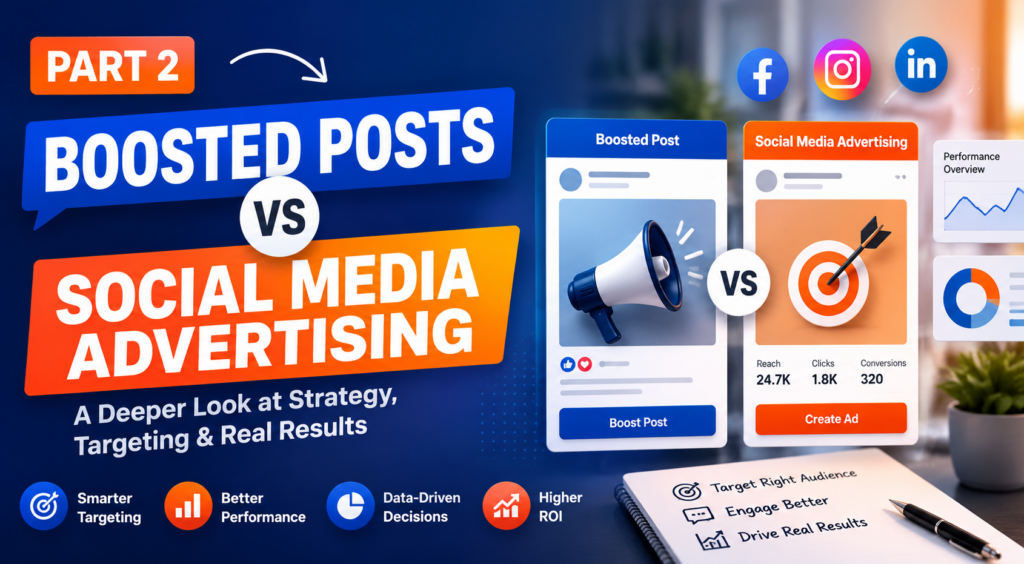
In Part 1, we explored the fundamental differences between boosted posts vs social media ads. We examined what each format is, where boosted posts are most effective, and the advantages and limitations businesses should consider before investing their advertising budget.
In this second part, we move beyond the basics and examine the strategic factors that separate simple content promotion from fully developed advertising campaigns.
Audience Targeting: Precision Matters
One of the most significant differences between boosted posts and social advertising campaigns lies in audience targeting.
Boosted posts generally offer access to broad targeting options such as:
- Age
- Gender
- Location
- Interests
These settings can be sufficient for awareness campaigns but they provide limited precision.
Full advertising campaigns allow marketers to create highly specific audience segments using advanced data sources.
These may include:
- Website visitors
- Customer databases
- Previous purchasers
- Email subscribers
- Mobile app users
In addition, businesses can create lookalike audiences based on their existing customers, helping them reach individuals who share similar characteristics and behaviours.
This level of targeting enables organisations to focus budgets on users who are significantly more likely to convert.
Advertising Placements: Expanding Reach Across Platforms
Boosted posts are generally confined to a limited number of placements, primarily within social media feeds.
Advertising campaigns provide access to a much broader ecosystem.
Depending on the platform, businesses may utilise:
- Stories
- Reels
- Messenger placements
- Audience Network placements
- Sponsored messages
- Conversation ads
- Marketplace placements
- Video placements
The ability to distribute content across multiple environments creates more opportunities to engage users at different stages of the buying journey.
It also allows advertising platforms to optimise delivery based on where performance is strongest.
Reporting and Measurement Capabilities
Visibility and engagement are useful indicators but they rarely provide a complete picture of marketing effectiveness.
Boosted posts typically focus on metrics such as:
- Reach
- Impressions
- Reactions
- Comments
- Shares
- Link clicks
While these figures provide useful context, they do not necessarily demonstrate commercial impact.
Advertising campaigns offer substantially deeper reporting capabilities.
Businesses can measure:
- Leads generated
- Sales completed
- Cost per acquisition
- Conversion rates
- Return on ad spend
- Customer journey attribution
This level of analysis allows marketing teams to identify which audiences, creatives and placements contribute most effectively to business growth.
Why Social Ads Deliver Greater Strategic Value
The primary strength of social advertising campaigns is flexibility.
Businesses gain complete control over:
Creative Assets
Dedicated campaign creative can be developed specifically for advertising purposes rather than relying on existing social posts.
Campaign Objectives
Marketers can optimise for outcomes that directly support business goals, including:
- Lead generation
- Product sales
- Event registrations
- Website conversions
- Recruitment campaigns
Budget Allocation
Campaign budgets can be distributed across multiple audience segments, allowing businesses to identify the highest-performing opportunities.
Automated Optimisation
Advertising platforms use machine learning and behavioural data to improve delivery and maximise results over time.
These capabilities are simply unavailable through standard boosted posts.
The Challenges of Full Advertising Campaigns
While social ads offer greater potential, they also introduce additional complexity.
Increased Setup Time
Campaign planning requires careful consideration of objectives, audience strategy, creative development and tracking implementation.
Higher Skill Requirements
Effective campaign management often requires experience with advertising platforms, performance analysis and optimisation techniques.
Ongoing Monitoring
Campaigns require regular review to maintain efficiency and prevent unnecessary expenditure.
Without proper oversight, budgets can be consumed quickly with limited return.
For this reason, many organisations invest in specialist marketing support or dedicated paid media expertise.
Budget Considerations
The cost of social advertising varies significantly depending on factors such as:
- Industry competitiveness
- Audience size
- Geographic location
- Campaign objective
- Seasonal demand
- Creative quality
Awareness campaigns generally cost less than conversion-focused campaigns because the desired action is easier to achieve.
Businesses new to paid social often begin with modest budgets to establish performance benchmarks before increasing investment.
A gradual approach allows marketers to gather meaningful data while reducing financial risk.
Should Businesses Use Both Approaches?
For many organisations, the strongest strategy is not choosing one over the other but combining both.
A practical framework involves:
Step One: Validate Content Through Boosted Posts
Use boosted posts to identify messages, themes and creative formats that attract engagement and audience interest.
Step Two: Analyse Performance
Review engagement patterns, click-through rates and audience responses to identify high-performing content.
Step Three: Scale Through Advertising Campaigns
Take the strongest-performing concepts and build dedicated advertising campaigns around them, incorporating advanced targeting and conversion-focused objectives.
This process enables businesses to make advertising decisions based on real audience behaviour rather than assumptions.
Final Thoughts
Boosted posts and social media advertisements serve different purposes within a modern digital marketing strategy.
Boosted posts offer a practical and accessible way to increase visibility, promote successful content and build initial momentum.
Social advertising campaigns provide the strategic depth required for lead generation, customer acquisition, conversion tracking and long-term growth.
Rather than viewing them as competing options, businesses should consider how each can contribute to a broader marketing framework. When used together, boosted posts can help identify opportunities, while advertising campaigns can transform those opportunities into measurable commercial results.
The most successful social media strategies are rarely built on a single tactic. They combine audience insight, creative excellence, strategic targeting and continuous optimisation to deliver sustainable business outcomes.
With years of industry experience and a passion for driving digital success, Aimee Digital Marketing is your trusted partner for digital marketing. From eye-catching graphic design and responsive website development to strategic social media management, engaging content creation and effective email marketing, we provide comprehensive solutions to help your brand grow and thrive online. For any enquiries or assistance, call us at 0203 038 3388. Follow us on Facebook, Instagram, TikTok and YouTube to stay updated with our latest work and digital marketing tips.