
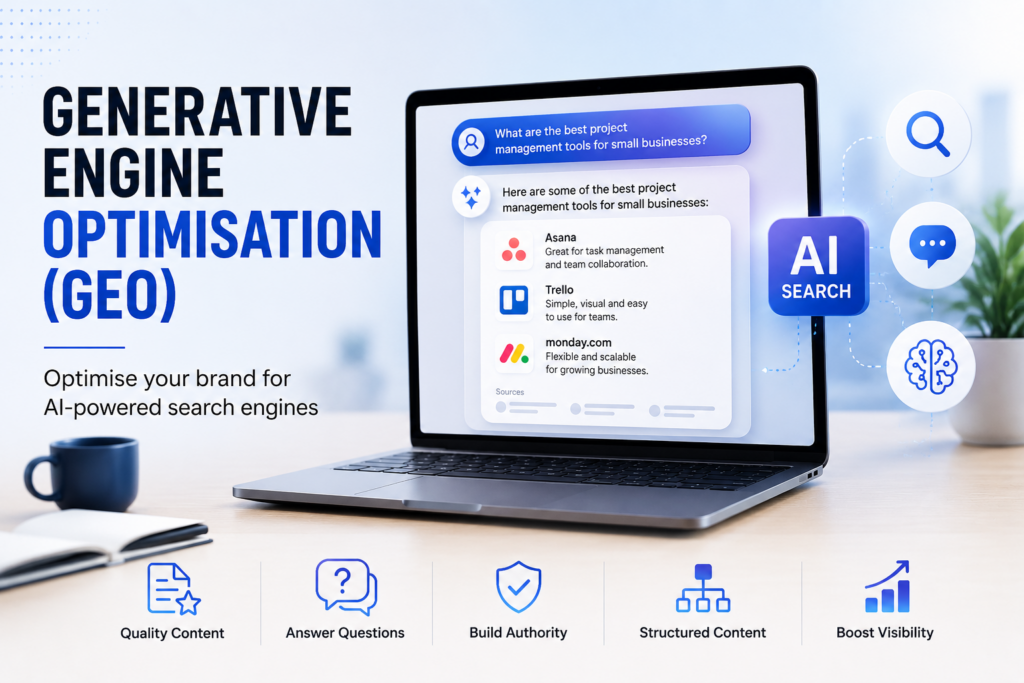
As artificial intelligence continues to transform the way people search online, businesses are beginning to rethink how they approach digital visibility. Traditional search engines are no longer the only place users go for answers. Today, platforms such as ChatGPT, Claude, Gemini and Perplexity are becoming trusted sources of information, recommendations and buying advice.
This shift has introduced a new concept in digital marketing: Generative Engine Optimisation (GEO).
GEO is quickly becoming an essential strategy for brands that want to remain visible in AI-generated search experiences and stay ahead of competitors in the evolving search landscape.
What Is Generative Engine Optimisation?
Generative Engine Optimisation (GEO) is the process of improving your brand’s visibility within AI-powered search engines and conversational AI tools.
Unlike traditional search engines that display a list of links, generative engines create direct answers to a user’s question by analysing information from across the web. These AI systems gather content, identify trusted sources and generate personalised responses in real time.
For businesses, this means the goal is no longer simply ranking on page one of Google. Instead, brands now need to position themselves as credible, authoritative sources that AI platforms are likely to reference, recommend or cite within their generated responses.
For example, if a user asks:
“What are the best laptops for graphic designers?”
An AI engine may provide a shortlist of recommended products along with citations from trusted websites. Brands featured in those responses gain valuable exposure, authority and potential conversions.
In many ways, being mentioned by an AI tool is becoming the modern equivalent of ranking highly in traditional search results.
How GEO Differs from Traditional SEO
Although GEO and Search Engine Optimisation (SEO) share similarities, they are not identical strategies.
Traditional SEO focuses on improving rankings within search engine result pages (SERPs). Businesses optimise content to appear among multiple search listings, giving users several opportunities to click through to their website.
Generative AI changes that dynamic significantly.
Instead of presenting ten blue links, AI engines often generate a single, comprehensive answer. This creates far fewer opportunities for brands to gain visibility.
Key Differences Between SEO and GEO
| SEO | GEO |
| Focuses on ranking webpages | Focuses on being referenced in AI responses |
| Optimises for search engines like Google | Optimises for AI tools like ChatGPT and Perplexity |
| Users browse multiple search results | Users receive one consolidated answer |
| Click-through rates are essential | Brand mentions and citations are increasingly important |
| Keywords are highly influential | Context, authority and clarity matter more |
This means brands must adapt their content strategy to suit the way AI systems collect and interpret information.
Why GEO Matters for Businesses
AI-powered search tools are rapidly changing consumer behaviour. More users are now relying on conversational AI for:
- Product recommendations
- Service comparisons
- Buying decisions
- Educational content
- Research and advice
- Local business suggestions
As AI adoption increases, brands that fail to optimise for generative engines risk losing visibility to competitors that do.
Businesses investing in GEO early can benefit from:
- Increased brand authority
- Greater online visibility
- Higher trust among users
- More qualified traffic
- Improved long-term digital presence
Simply put, GEO is becoming a critical part of modern digital marketing.
How Generative Engine Optimisation Works
Generative AI tools rely heavily on trustworthy, well-structured and informative content. These systems analyse enormous volumes of online data to determine which sources deserve inclusion in their responses.
While the exact algorithms remain proprietary, several clear optimisation patterns are emerging.
1. Create High-Quality, Expert Content
AI engines prioritise content that demonstrates expertise, authority and relevance.
Thin, repetitive or poorly written content is far less likely to be referenced by generative AI systems. Instead, brands should focus on producing genuinely valuable material that answers real user questions in depth.
Effective GEO content should:
- Provide original insights
- Demonstrate subject expertise
- Be factually accurate
- Offer practical value
- Address user intent clearly
Long-form educational content, detailed guides and expert commentary tend to perform particularly well within AI-generated search experiences.
2. Structure Content Clearly
AI systems rely on content structure to interpret information effectively.
Well-organised pages help AI models identify key topics, extract answers and understand context more efficiently.
To improve content structure:
- Use clear headings and subheadings
- Break information into short sections
- Include bullet points and tables where appropriate
- Add FAQ sections
- Use schema markup where relevant
A logical content hierarchy improves both human readability and AI comprehension.
3. Answer Questions Directly
Many AI searches are conversational and question-based.
Users commonly ask things such as:
- What is the best CRM for small businesses?
- How does SEO work?
- Which headphones are best for remote working?
Brands that answer these questions directly and concisely improve their chances of being referenced in AI-generated responses.
Creating dedicated FAQ content and addressing common customer queries can be especially effective for GEO.
4. Build Brand Authority Across the Web
AI tools do not rely solely on your website. They also evaluate how frequently your brand is mentioned across trusted sources online.
This includes:
- Industry publications
- Review platforms
- News websites
- Forums
- Business directories
- Social media discussions
The more your brand appears within reputable sources, the more likely AI engines are to view your business as trustworthy and authoritative.
Digital PR, link building and online reputation management therefore play an important role in GEO strategy.
5. Optimise for Topical Authority
Rather than creating isolated pieces of content, successful GEO strategies focus on building complete topic ecosystems.
AI engines favour websites that demonstrate broad expertise within a specific niche.
For example, a cybersecurity company should publish comprehensive content covering:
- Data protection
- Network security
- Phishing prevention
- Endpoint security
- Compliance regulations
- Cybersecurity trends
This signals deeper authority to AI systems and increases the likelihood of inclusion within AI-generated answers.
Can Brands Really Appear in AI Results?
Yes, absolutely.
Although AI-generated search is still evolving, businesses can already influence their visibility within generative engines.
Many of the core principles overlap with strong SEO practices, particularly around:
- Quality content
- User intent
- Authority
- Trustworthiness
- Structured information
However, GEO requires a more refined focus on becoming a trusted source rather than simply ranking for keywords.
Brands that consistently provide useful, accurate and well-structured information are far more likely to appear within AI-generated recommendations and citations.
The Relationship Between GEO and SEO
One of the most important things to understand is that GEO does not replace SEO — it builds upon it.
Strong SEO foundations remain essential because AI engines often rely on highly ranked and authoritative web content when generating answers.
In practice, effective GEO strategies often strengthen traditional SEO performance as well.
By focusing on:
- Better content quality
- Improved site structure
- User-focused information
- Topical expertise
- Strong brand signals
Businesses can improve visibility across both traditional search engines and AI-powered search experiences simultaneously.
Challenges of Generative Engine Optimisation
Although GEO presents exciting opportunities, it also introduces new challenges for marketers.
Limited Visibility Opportunities
Traditional search results provide multiple ranking positions. AI-generated answers may only reference a handful of sources.
Competition for inclusion is therefore much more intense.
Reduced Website Clicks
Users may receive complete answers directly from AI tools without visiting websites, potentially reducing organic traffic.
Brands must therefore focus on visibility, authority and influence — not just clicks.
Constantly Evolving AI Models
Generative AI technology is changing rapidly. Optimisation strategies that work today may evolve significantly over time.
Businesses need to stay adaptable and continuously monitor AI search trends.
The Future of GEO
Generative Engine Optimisation is still in its early stages, but its importance is growing rapidly.
As AI-powered search becomes more integrated into everyday browsing behaviour, brands that invest in GEO now will be better positioned for long-term success.
Future digital marketing strategies will likely combine:
- Traditional SEO
- GEO
- Content marketing
- Digital PR
- Brand authority building
- AI-focused optimisation
Businesses that understand how AI engines interpret and recommend information will gain a significant competitive advantage in the years ahead.
Final Thoughts
Generative Engine Optimisation represents the next evolution of online visibility.
As users increasingly turn to AI platforms for information, recommendations and decision-making, brands must adapt their content and digital strategies accordingly.
The fundamentals remain familiar: create excellent content, answer questions clearly and establish authority within your industry.
However, GEO shifts the focus from simply ranking in search engines to becoming a trusted source that AI systems choose to reference.
For businesses willing to embrace this change early, GEO offers a powerful opportunity to strengthen brand visibility and stay ahead in the future of search.
With years of industry experience and a passion for driving digital success, Aimee Digital Marketing is your trusted partner for digital marketing. From eye-catching graphic design and responsive website development to strategic social media management, engaging content creation and effective email marketing, we provide comprehensive solutions to help your brand grow and thrive online. For any enquiries or assistance, call us at 0203 038 3388. Follow us on Facebook, Instagram, TikTok and YouTube to stay updated with our latest work and digital marketing tips.