
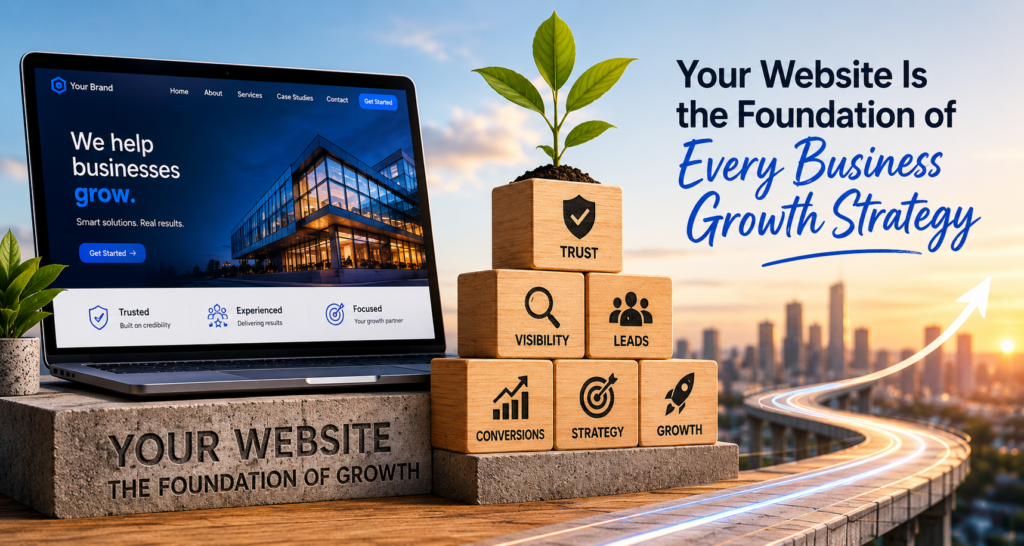
Every business owner wants growth. More clients, more revenue, broader reach. Yet many pour resources into advertising campaigns, social media accounts and sales initiatives whilst overlooking the single asset that either validates or undermines every other effort they make: their website.
In 2026, a website is not a digital brochure. It is not a box to tick during a brand refresh. It is the operational centre of a business’s entire commercial presence. Whether a prospect discovers you through a paid advertisement, a referral, a social media post, or a search engine result, the journey almost always ends at the same destination: your website. What happens in those first few seconds determines whether that prospect becomes a customer or quietly moves on to a competitor.
This article examines why a well-built, strategically considered website remains the most important investment a business can make and why no growth strategy in 2026 stands on solid ground without one.
The Modern Customer Journey Begins Online
Before contacting a business, customers now conduct extensive online research. They compare providers, read reviews, evaluate credibility and assess professionals often within minutes.
Research shows that consumers regularly rely on online searches and reviews before making purchasing decisions.
This means your website is often the first commercial interaction a customer has with your brand. If the experience feels outdated, slow or unclear, potential clients may never progress further.
In practical terms, your website now influences:
- Brand perception
- Customer trust
- Search visibility
- Conversion rates
- Lead quality
- Revenue growth
Businesses investing heavily in advertising while neglecting their websites are effectively directing traffic towards weak conversion environments.
Trust Has Become a Competitive Advantage
In an AI-driven digital landscape, trust signals are becoming more influential than ever. Consumers increasingly expect businesses to demonstrate legitimacy, transparency and credibility before engagement.
Recent reporting on AI search behaviour found that businesses with stronger review visibility and credible online presence appear more frequently in AI-generated search results.
This shift has significant implications for growth strategies in 2026.
A professional website now acts as a trust infrastructure. Customers assess:
- Design quality
- Security standards
- Client reviews
- Response times
- Content authority
- Mobile usability
- Accessibility
- Brand consistency
A poorly maintained website creates hesitation. A well-structured website creates confidence.
Trust is particularly critical for service-based industries where customers are purchasing expertise rather than physical products. In sectors such as immigration, finance, legal services and healthcare, website quality directly shapes perceived credibility.
Search Engines Now Prioritise Experience, Not Just Keywords
Search visibility in 2026 depends heavily on website quality and user experience.
Google’s evolving algorithms increasingly reward websites that demonstrate:
- Fast loading speeds
- Mobile-first performance
- Helpful content
- Technical optimisation
- User engagement
- Secure browsing environments
Search engines are no longer evaluating websites solely on keyword usage. They are measuring how effectively websites serve users.
This is one reason businesses with strong user experience often achieve better long-term SEO performance than competitors relying on outdated optimisation tactics.
Modern websites must therefore balance three objectives simultaneously:
- Technical performance
- Customer experience
- Commercial conversion
Businesses that fail to modernise their websites risk declining visibility, weaker engagement and reduced lead generation.
Your Website Influences Every Marketing Channel
Every marketing activity eventually leads back to your website.
Whether traffic comes from:
- Google search
- Paid advertising
- LinkedIn campaigns
- Social media
- Email marketing
- PR coverage
- AI search assistants
…the website remains the final decision-making environment.
A weak website reduces the effectiveness of every external marketing investment.
For example:
- Strong advertising cannot compensate for poor conversion design
- Excellent SEO cannot overcome low trust signals
- High social engagement means little if visitors abandon the website immediately
This is why businesses focused on sustainable growth increasingly prioritise website optimisation before expanding advertising budgets.
The website is not separate from the growth strategy. It is the operational foundation of the growth strategy.
Mobile Performance Is Now Essential
Mobile traffic continues to dominate across industries. Yet many businesses still operate websites designed primarily for desktop users.
Modern customers expect:
- Fast mobile loading times
- Clear navigation
- Frictionless enquiry forms
- Click-to-call functionality
- Mobile-friendly content formatting
Research and industry analysis consistently show that slow or poorly optimised mobile experiences reduce conversions significantly.
In 2026, mobile usability is not simply a design preference, it is a revenue factor.
AI Is Changing How Customers Discover Businesses
The rise of AI-driven search platforms is reshaping digital visibility.
Consumers increasingly use AI assistants to:
- Compare providers
- Research services
- Evaluate credibility
- Discover recommendations
This creates a new challenge for businesses: visibility now depends not only on SEO but also on digital authority and trustworthiness.
Businesses with strong websites, structured information, authoritative content and credible reviews are more likely to appear in AI-generated recommendations.
This means your website must now serve both human users and AI systems.
Clear information architecture, strong expertise signals and reliable content are becoming essential competitive advantages.
Conversion-Focused Design Drives Revenue Growth
Modern websites are designed around customer behaviour, not aesthetics alone.
A high-performing website guides visitors towards action through:
- Clear messaging
- Strategic calls to action
- Simplified navigation
- Trust-building elements
- Streamlined enquiry journeys
Businesses increasingly recognise that website design is not merely creative work, it is commercial strategy.
According to industry analysis, high-converting websites are built around clarity, trust and reduced friction.
Small improvements in conversion performance can significantly increase revenue without increasing advertising spend.
For example:
- Faster pages improve engagement
- Better forms increase enquiries
- Stronger trust signals improve conversion rates
- Clearer messaging reduces abandonment
This is why website optimisation often produces stronger long-term ROI than short-term marketing campaigns.
Businesses Without Strong Websites Will Struggle to Scale
Growth becomes increasingly difficult when digital infrastructure is weak.
Businesses attempting to scale with outdated websites often experience:
- Rising customer acquisition costs
- Lower conversion rates
- Reduced search visibility
- Poor lead quality
- Weaker customer confidence
By contrast, businesses with strong websites create scalable growth systems capable of supporting:
- SEO expansion
- Paid advertising
- Automation
- AI integration
- International reach
- Lead nurturing
- Customer retention
The website becomes the operational core of modern business development.
What a Strong Website Actually Looks Like in 2026
Understanding the strategic importance of a website and knowing what makes one effective are two different things. A website that genuinely supports business growth in 2026 has several defining characteristics.
Clear communication of value. Within seconds of arriving, a visitor should understand what the business does, who it serves and why it is worth their time. Ambiguity at this stage costs conversions.
Intuitive structure and navigation. 76% of users consider ease of use the most essential aspect of website design. A site that requires effort to navigate loses visitors who have no obligation to persist.
Mobile performance. With the majority of web traffic now arriving via mobile devices, a website that performs poorly on smaller screens is functionally broken for most of its audience. Mobile optimisation is not a feature, it is a baseline requirement.
Technical reliability and speed. Speed directly affects both user retention and search ranking. A well-built website is one that has been engineered to perform, not simply assembled quickly.
Content that builds authority. Regular, substantive content that addresses the questions and concerns of a target audience improves search visibility and builds the kind of trust that converts visitors into customers.
Clear calls to action. A website exists to prompt decisions. Whether the desired action is a phone call, a form submission, a purchase, or a consultation request, the pathway to that action should be obvious and frictionless.
The Cost of Getting It Wrong
Businesses sometimes treat the website as a one-time project rather than an ongoing investment. A site is built, launched, and then largely left alone, updated occasionally but never really reviewed against the goals it is supposed to serve.
The cost of this approach is rarely visible in a single quarter. It accumulates gradually, in the form of visitors who arrive and leave, campaigns that underperform, leads that never convert, and a brand perception that quietly erodes. By the time the problem becomes obvious, significant commercial ground has often been lost.
The inverse is equally true. Businesses that treat their website as a living, central part of their commercial operation investing in design, performance, content, and strategy on an ongoing basis build compounding advantages that become increasingly difficult for competitors to close.
Final Thoughts
In 2026, a company’s website is no longer a supporting marketing asset. It is the foundation of commercial growth. It shapes customer trust, influences purchasing decisions, strengthens search visibility and determines the effectiveness of every marketing investment.
Businesses that continue treating their websites as secondary priorities will struggle to compete in increasingly digital and AI-driven markets. Those that invest strategically in performance, trust, usability and content will position themselves for stronger visibility, higher conversions and sustainable long-term growth.
The businesses winning in 2026 are not simply the loudest. They are the most credible, accessible and digitally prepared. And in nearly every case, that advantage begins with the website.
With years of industry experience and a passion for driving digital success, Aimee Digital Marketing is your trusted partner for digital marketing. From eye-catching graphic design and responsive website development to strategic social media management, engaging content creation and effective email marketing, we provide comprehensive solutions to help your brand grow and thrive online. For any enquiries or assistance, call us at 0203 038 3388. Follow us on Facebook, Instagram, TikTok and YouTube to stay updated with our latest work and digital marketing tips.